

👋 Hey, I’m Nikki. Each week I write about UX research strategy, communicating impact, and using AI to do your best work. For more: Claude Skills Bundle | Claude Agents | AI Prompt Library | Team Training | AI Courses for UXRs
P.S. Paid subscribers get access to full archive, all content, a private Slack community, Substack lives, and a hub of templates, scripts, and mini-courses
I sometimes feel bad for personas because they can get such a bad reputation. Well, to be fair, all research deliverables can fall into a bad reputation, from customer journey maps to reports to charts.
However, I will say this:
It 👏🏻 is 👏🏻 not 👏🏻 the 👏🏻 persona’s 👏🏻 fault 👏🏻
(I’m really loving this whole clapping at every word thing recently - what an age we live in that emojis bring emotion to text 😜).
Personas (and other deliverables) are often set up for failure due to many different reasons:
They aren’t created with the right information, so they aren’t actionable (I know, I hate that word too and I’ll explain it better later)
There are too many created at once, so no one knows which to use when
There isn’t enough deep research done to create them, resulting in shallow information
See? The problem doesn’t come inherently from the persona as a deliverable.
So, what is the problem?
I’ve created and seen many personas in my career, and the number one problem, the number one reason people hate them, is:
No one uses the persona after it’s created.
We do all this work for the persona to sit in a corner, sad, alone, and unused. It’s like someone who doesn’t get picked for the dodgeball team. And then we (and others) think:
“What a colossal waste of time!”
And, yes, if the persona goes unused, it is a huge waste of time and energy, not only for you as the researcher but for your team and also your participants. It can be hugely frustrating to create an deliverable that goes unused but, when one takes such a large effort, it’s even more disappointing.
With the personas I have seen, I’m not surprised product/tech people dislike them. So, let’s look at a few of my previous unideal personas* before I bring you through my process of building better personas.
*Please don’t get discouraged if your personas look like this. We all start somewhere and it’s about improvement!
Before we rip apart my previous work (kill your darlings), I just want to remind us what the point and goal of a persona is:
Personas are a tool to help our teams more deeply understand the context of our users so that the team can make better decisions on:
What types of features/products/services to focus on
What to improve in the current features/products/services
What to create next that aligns with users’ needs, pain points, and goals
Ultimately, personas are about alignment. They aren’t magical unicorns that will give us answers to all our questions. We still need to answer the questions, but personas give us data to better answer those questions in a more informed and user-centric way.
My first-ever personas
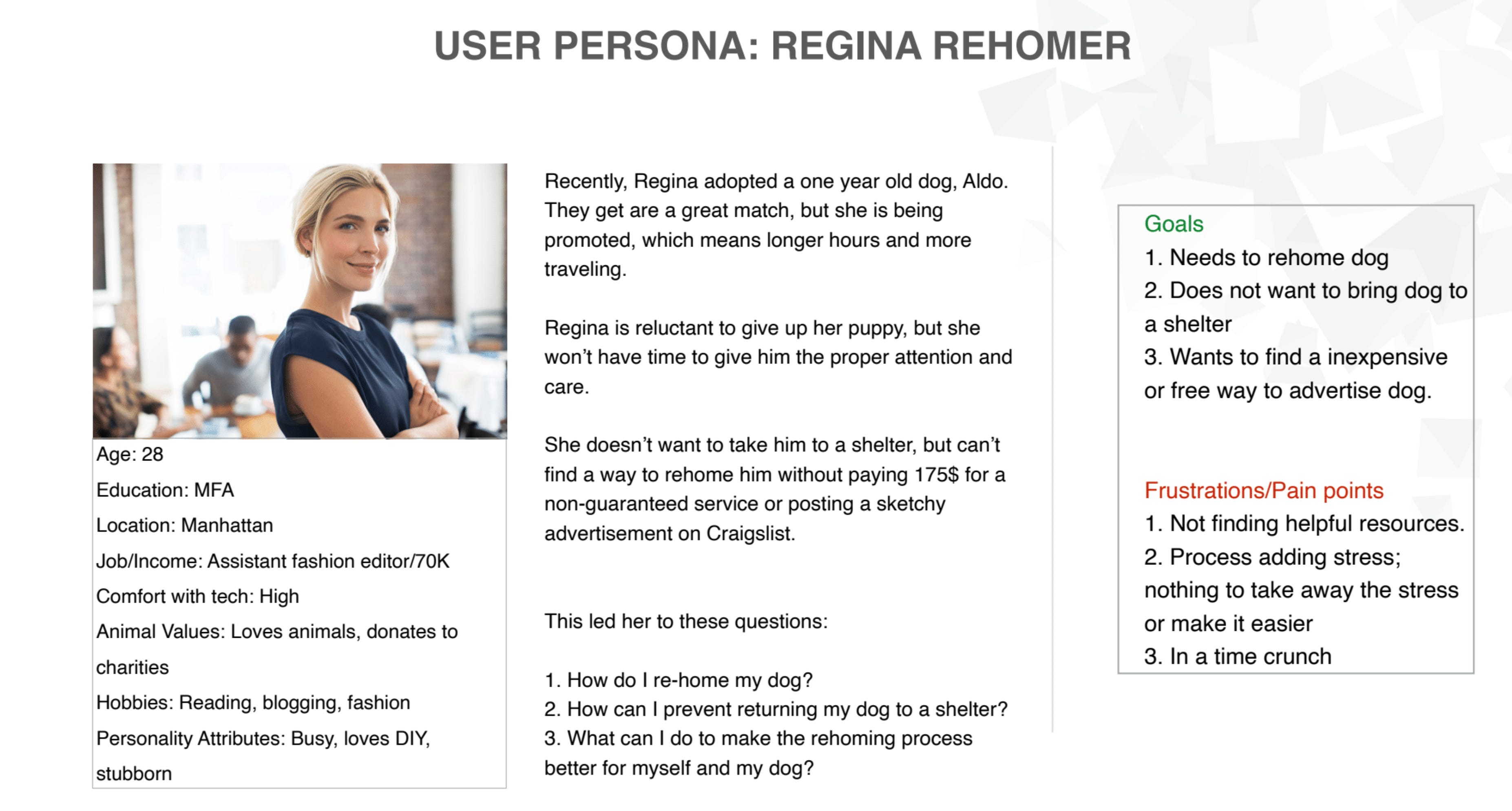
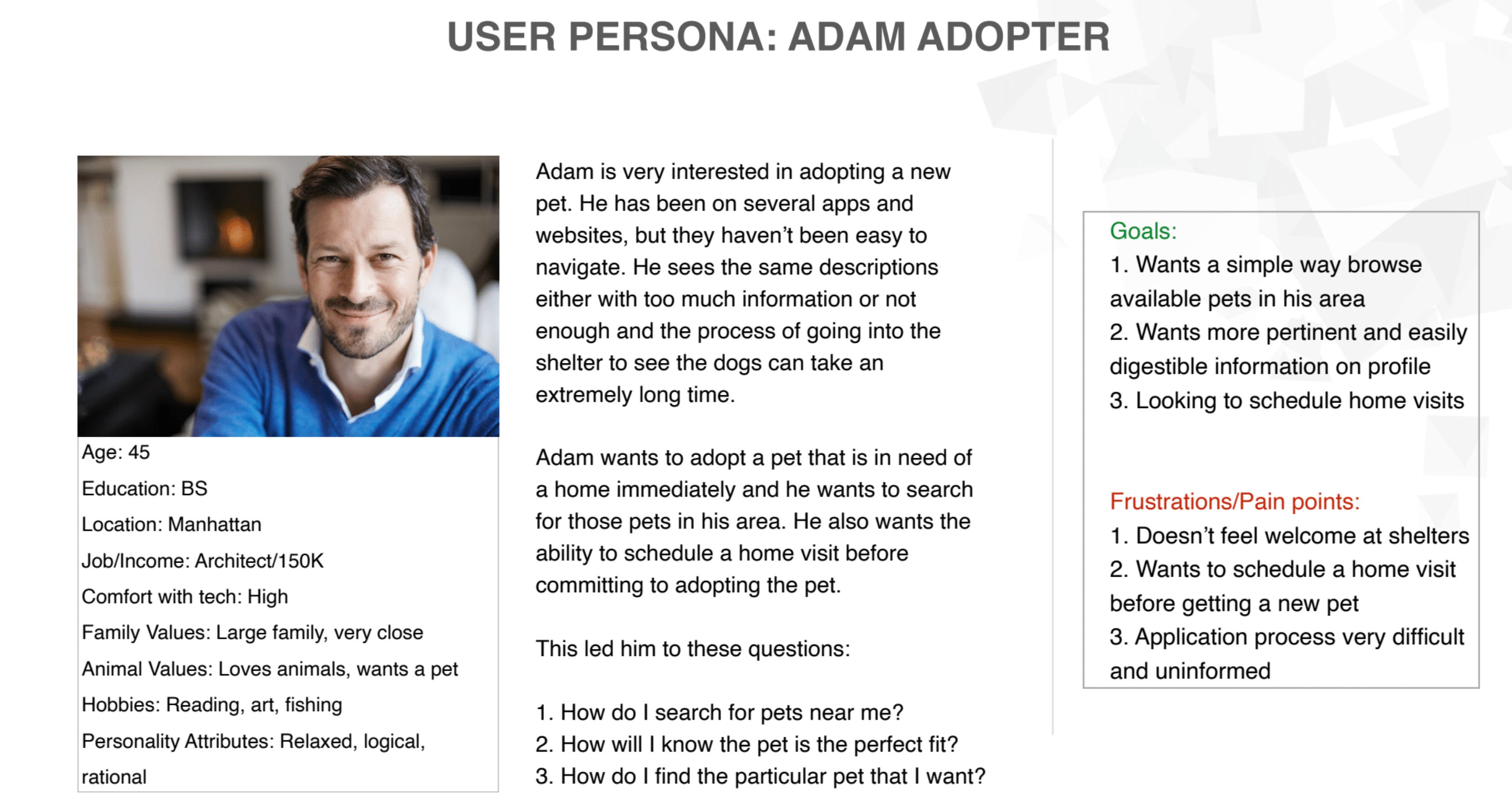
My first ever user research personas
Aw - good memories. I created these personas in 2014, and they were the first I had ever created (as you may be able to tell).
This was a personal project I did as a case study for applying to user research jobs. The project was about how to rehome animals from shelters better by connecting people who needed to rehome their pets directly with those who wanted to adopt pets. Great concept, in my humble opinion.
However, looking at these personas, and going back to what I mentioned above as the point of personas, you might see where they fall short.
Although I did put in a little story (which I actually like to do now too), there is such limited information in these personas. If I gave these to a team and asked them to make decisions based on them, I wouldn’t be surprised if they told me that they couldn’t do so. In fact, I’d be blown away if anyone said they could make more informed decisions about the topic with these personas.
So, what really doesn’t work about them?
The information in these personas is incredibly vague and shallow. Look at some of the frustrations and pain points for Regina:
“In a time crunch”
“Not finding helpful resources”
And now for Adam:
“Application process very difficult and uninformed”
WHAT DO THESE MEAN?
Absolutely nothing. If I gave you this information and told you to make a product, you’d look at me like I’m Fluffy from Harry Potter (although I think Fluffy is cute). There is absolutely no context, no supporting information. Time crunch? Everyone’s in a time crunch. Helpful resources? Which ones? HOW IS THE APPLICATION PROCESS DIFFICULT?
Also, what do someone’s hobbies, job, and personalily attributes have to do with this topic? Regina is “stubborn” (lol). HOW DOES THAT HELP US MAKE DECISIONS? It doesn’t.
Ah, it hurts me a little bit to see this persona, but IT’S OKAY. We live and learn.
Personas like these exist, and it’s no wonder that people hate them. As a tool, this is completely useless. It’s like, instead of a hammer to hit a nail, I just gave you a stick I found from a tree. A broken stick that’s been run over. These personas aren’t making anyone’s life easier.
My second try
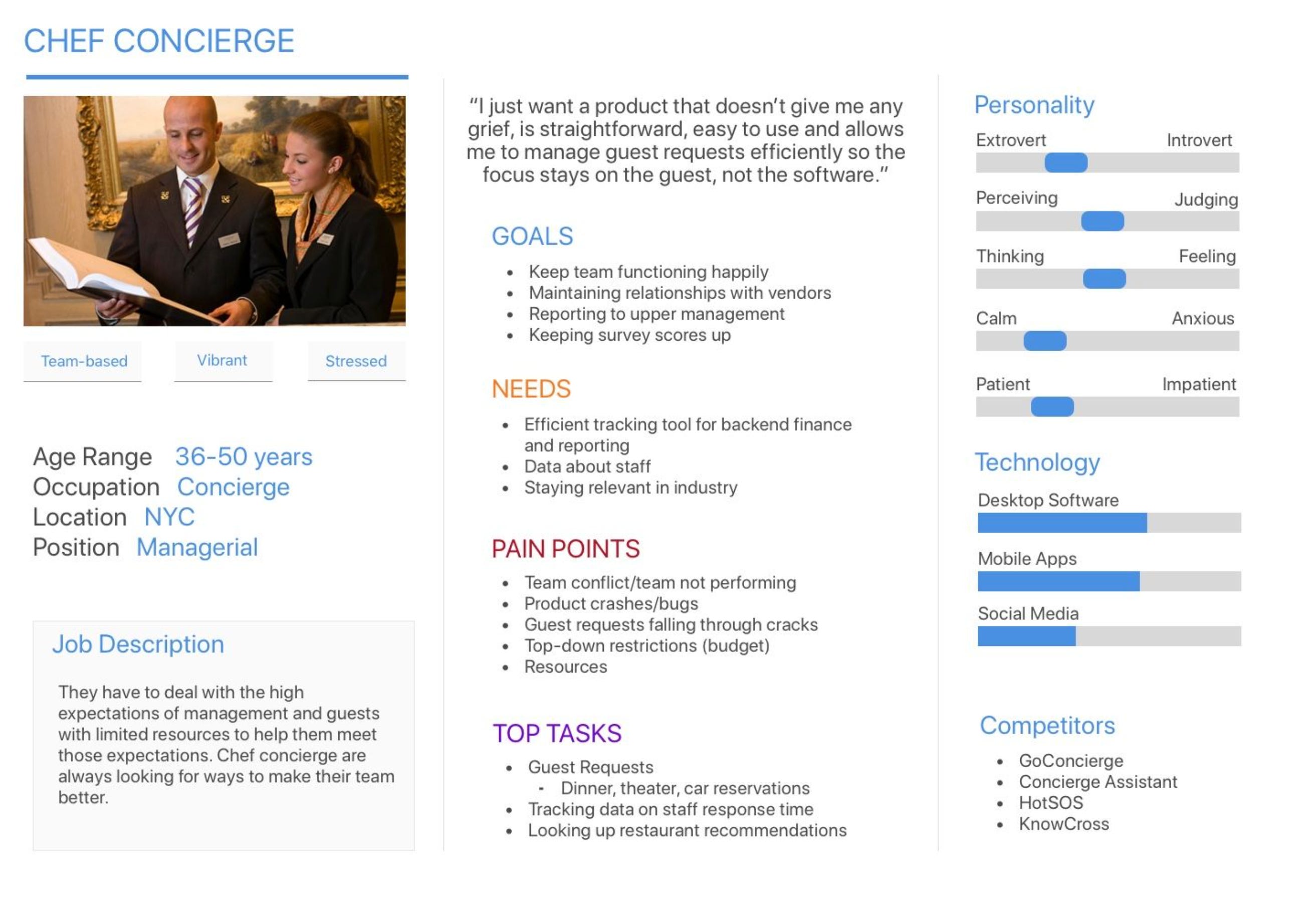
You might recognize this format from my first resume 😂 If you couldn’t already tell, I am not a designer by trade.
But, really, personas don’t have to be pretty. They need to be filled with actionable and contextual information that help your team make better decisions. The sad part is, this persona wasn’t a personal project, it was something I took MONTHS to work on at my first role as a user researcher.
This persona was based on a hospitality platform that hotel staff had to use.
So, let’s break down what isn’t working in this:
Sliders. No. Just no sliders on anything. Sliders aren’t helpful and usually convey data that is useless or made up. We aren’t here to take a personality test and score on the Myers-Briggs, so why does it matter putting thinking/feeling or perceiving/judging? This gives us NO useful data on users and takes up a good chunk of the deliverable
Again, all of the information is SO shallow and not at all contextualized for our teams:
What does it mean to keep a team functioning happily?
What kind of data do they need about staff?
What resources are pain points and why?
WHAT PRODUCT CRASHES/BUGS? THAT’S A USABILITY ISSUE, NOT A PERSONA!!!!!!!
Why does it matter if they are on social media? AND WHAT DOES A PARTIAL BAR OF SOCIAL MEDIA EVEN MEAN?
Nothing in this persona screams deepening empathy or helping teams make better decisions. It’s just full of fluffy information.
Again, I have seen a lot of personas that look like this. They completely fail product teams because of the lack of actionable information.
Below, I walk you through the full process I use to build personas that teams actually use (and keep using):
The reverse-engineered persona workflow (so you stop guessing what belongs in a persona)
The two workshops that make personas useful (information-gathering + proto-personas)
Segmentation that doesn’t collapse into demographics (how to pick segments that guide product decisions)
The research + synthesis system for 20+ interviews (debriefs, mini-synthesis sessions, and what to prioritize)
Activation that prevents “persona poster syndrome” (how to embed personas into planning, ideation, and decisions)
Exclusively for paid subscribers
